

The Wisconsin Foundation and Alumni Association brought UW–Madison alumni and friends together on February 26, 2026, at the Wisconsin Club in Milwaukee for the latest installment of the Wisconsin Idea Spotlight series. The evening’s program, Frank Lloyd Wright in the 21st Century, featured an illuminating lecture by Anna Andrzejewski, the Frank Lloyd Wright Professor of Modern American Architecture at UW–Madison — a faculty position newly endowed in perpetuity by Natalie ’85 and Dan Erdman ’80, EMBA ’99. “I am humbled to be the first holder of this professorship,” Andrzejewski told the audience.
More Than a Style
Andrzejewski, a historian of modern American architecture who has taught at UW–Madison since 2000, opened by inviting the audience to see Wright not as a mythological figure, but as a man very much of his time — shaped by his Wisconsin landscape, his mentors, and the social and technological upheavals he witnessed across nine decades of life.
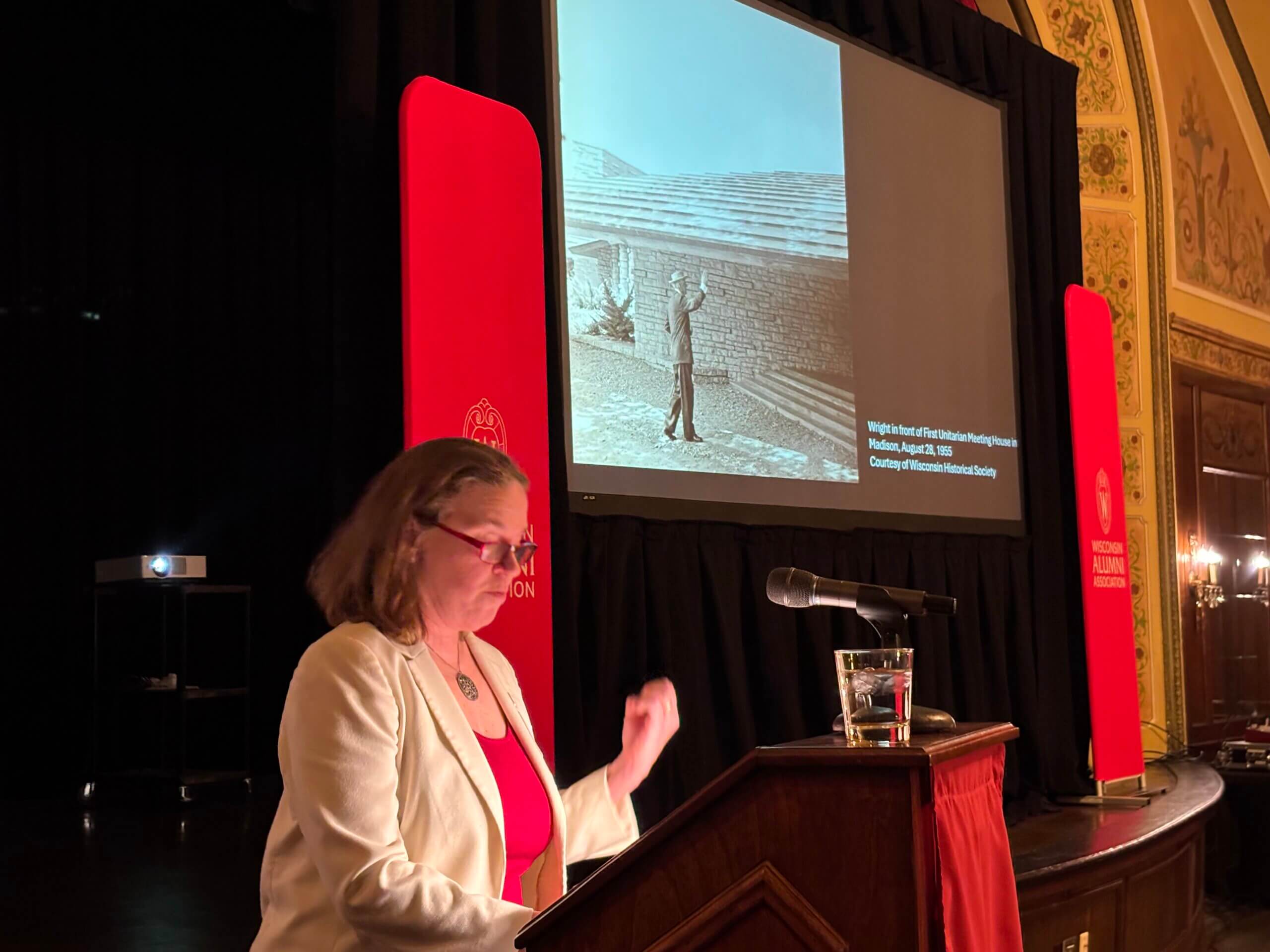
Born in Richland Center, Wisconsin, in 1867, Wright spent formative summers in the Wyoming Valley near Spring Green, farming with his extended family in the ancient, unglaciated terrain of the Driftless Area. Andrzejewski argued that the organic solutions those steep hillsides demanded of farmers — terrace the land or don’t farm at all — left a lasting impression on the young Wright and planted the seeds of what would become his lifelong philosophy of organic architecture.
That philosophy took shape in Chicago, where Wright apprenticed under Louis Sullivan, the progressive architect famous for the maxim, “Form follows function.” Wright would later refine that idea into something even more integrated: “Form and function are one.” It’s a subtle but significant distinction, and it became the lens through which Andrzejewski explored Wright’s enduring relevance.
Three Reasons Wright Still Matters
Andrzejewski organized her lecture around three themes — environment, technology, and cultural responsiveness — each illustrated through close readings of Wright’s buildings.
On the environment, she pointed to Taliesin in Spring Green, which Wright famously said was built of the hill, not simply on it. She brought the concept closer to home with the lesser-known Pew House in Shorewood Hills, built over a ravine draining into Lake Mendota in the late 1930s. Students who visit today, she said, feel as though they’re suspended in the air above the lake. Wright paid homage to the trees and the ravine, letting the site shape the structure rather than imposing a form upon it.
She also introduced the audience to the solar hemicycle house on Madison’s west side — a 1948 home for journalist Herbert Jacobs and his wife, Katharine, that functioned as passive solar design decades before the term existed. Oriented around the summer equinox, it was built to embrace winter sunlight and deflect summer heat, with a berm in the back providing natural thermal insulation. “He was already thinking about sustainable solutions,” Andrzejewski noted, “almost as if he forecast climate precarity.”
On technology, Andrzejewski painted Wright as an enthusiastic early adopter who owned nearly 100 cars over his lifetime and once called the machine “the great forerunner of democracy.” His goal wasn’t technology for its own sake, but to use it as a lever for democratizing good design — to make quality architecture accessible to people of modest means. She traced this thread from his early American System-Built houses (the Burnham Block in Milwaukee being the most prominent surviving example), through his textile block houses of the 1920s, to his final collaboration with Madison builder Marshall Erdman on a line of prefabricated middle-income homes in the late 1950s.
When her colleague noted offhandedly that Wright’s roofs sometimes leaked — a well-known fact — Andrzejewski used it as a point of celebration rather than criticism. “Who else would try the things he tried?” At the Johnson Wax building in Racine, Wright pursued a vision of lily pad columns and a luminous forest-within-a-building; the technology didn’t always cooperate, but the boldness of the attempt is itself a lesson. “Sometimes the technology had to catch up with Wright,” she said. And in an age of artificial intelligence and material shortages, that model of bold, experimental thinking feels newly urgent.
On cultural responsiveness, Andrzejewski reminded the audience of the sheer sweep of history Wright witnessed — from mass immigration and industrialization to suburbanization, the invention of zoning, and the rise of the long-term amortized mortgage. His Usonian homes, designed for middle-income Americans beginning in the 1930s, were a direct response to all of it: efficient floor plans, carports, open-concept kitchens and dining areas, radiant heating, and a deliberate orientation away from the street to foster privacy and a connection with one’s own backyard. “He contributed to and helped shape what postwar suburban living would look like,” she said — not by accident, but by paying close attention to how Americans actually wanted to live.
She closed with his visionary (and unbuilt) Broadacre City, a decentralized community concept from the 1930s that grappled with social inequality, infrastructure, sustainability, and the role of government — questions, she noted, that her students recognize as still very much alive today.
The Lesson That Transcends Style
The evening’s takeaway wasn’t about prairie rooflines or horizontal geometry. Andrzejewski was emphatic: Wright’s legacy isn’t an aesthetic to be copied — it’s an approach to be learned from.
A student in one of her courses, visiting Monona Terrace and reflecting on Wright’s fascination with cars, perhaps put it best in a weekly journal entry that Andrzejewski shared with the Milwaukee audience: “Wright’s lifelong commitment was to improving how people lived.”
That commitment — to responsive design, to boldly engaging with environmental conditions, technological possibility, and the lived realities of everyday culture — is what Andrzejewski believes keeps Frank Lloyd Wright relevant in the 21st century. “Organic architecture,” she concluded, “is not about replicating things. It’s about seeking solutions.”
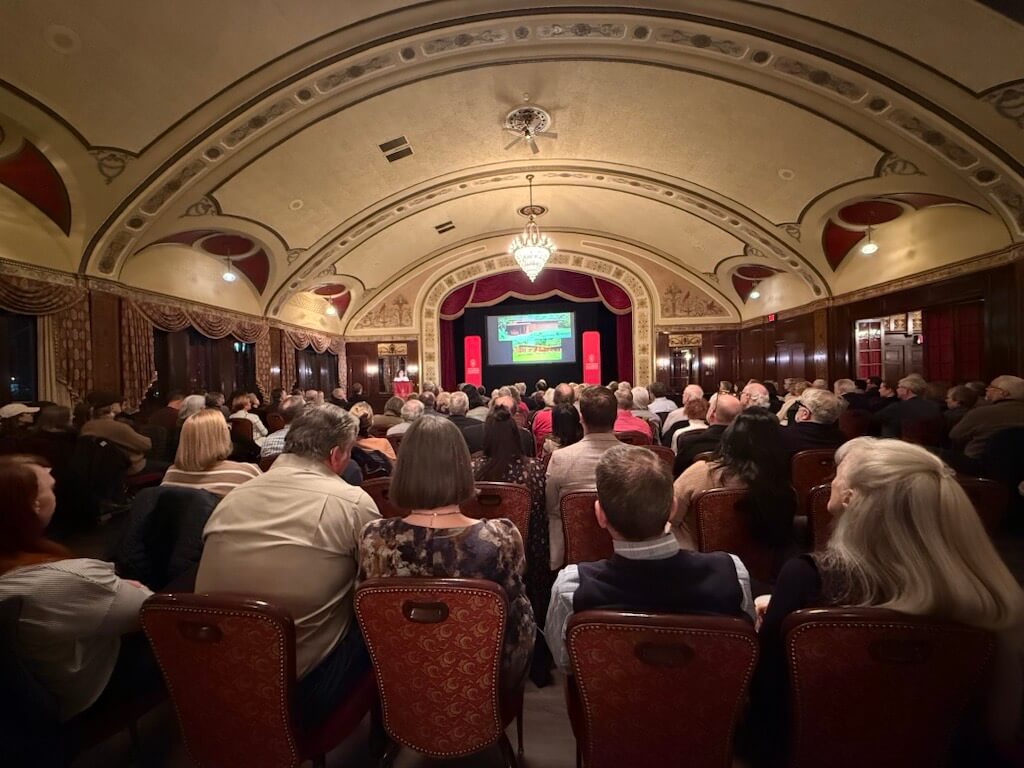
Badgers get together
The evening was a great opportunity for community engagement with alumni and friends, a time for the Badger community to come together and have the opportunity to build connections and share stories.
The Wisconsin Idea Spotlight series is part of the Wisconsin Alumni Association’s ongoing effort to bring Badgers together and strengthen connections within the UW–Madison community. Learn more about upcoming events at uwalumni.com/events.


