UW–Madison alumni, students, faculty, and community leaders gathered in Madison this spring for the Wisconsin Foundation and Alumni Association’s (WFAA’s) annual UW–Madison Day at the State Capitol — a day dedicated to connecting the university’s story with the elected officials who help shape its future.
The event brought advocates together for morning briefings, legislator meetings, a student research showcase in the capitol rotunda, faculty flash talks, and an afternoon lunch program featuring the UW’s outgoing chancellor, Jennifer Mnookin. This year’s gathering carried an added dimension of significance: a brand-new economic impact report — released just the day before — gave advocates fresh, compelling data to carry into their meetings.
Tell Your Story
The morning session opened with a clear message from WFAA’s managing director of state and university relations, Mike Fahey ’89: the most powerful thing any advocate can do is tell their own story to state lawmakers.
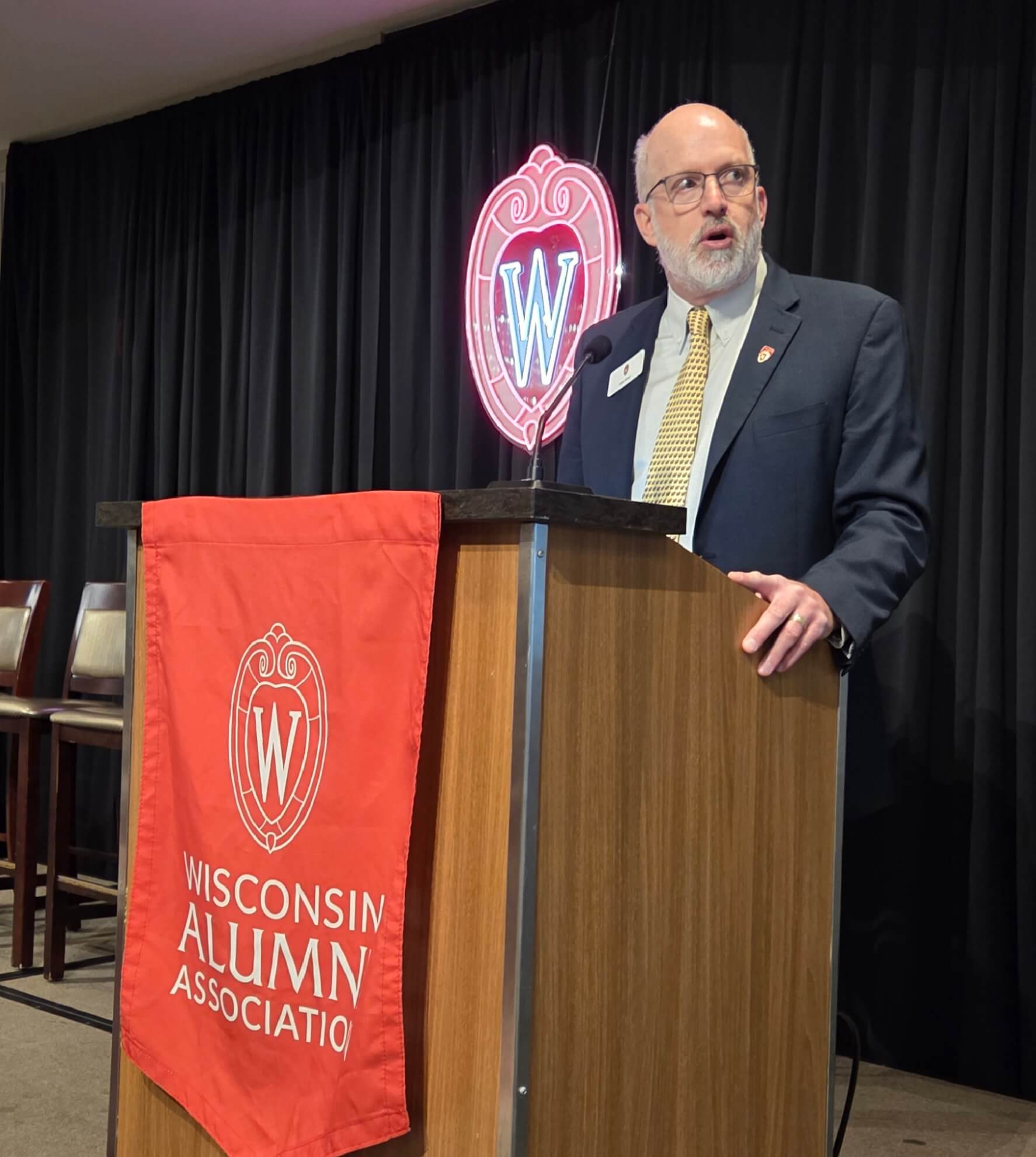
“The University of Wisconsin can’t tell your story,” Fahey told the assembled group. “We can’t tell your story of why you took time out of your day to be here — your story of how you became a student at the University of Wisconsin, or what you’re doing today in your community that is impactful and makes a difference.”
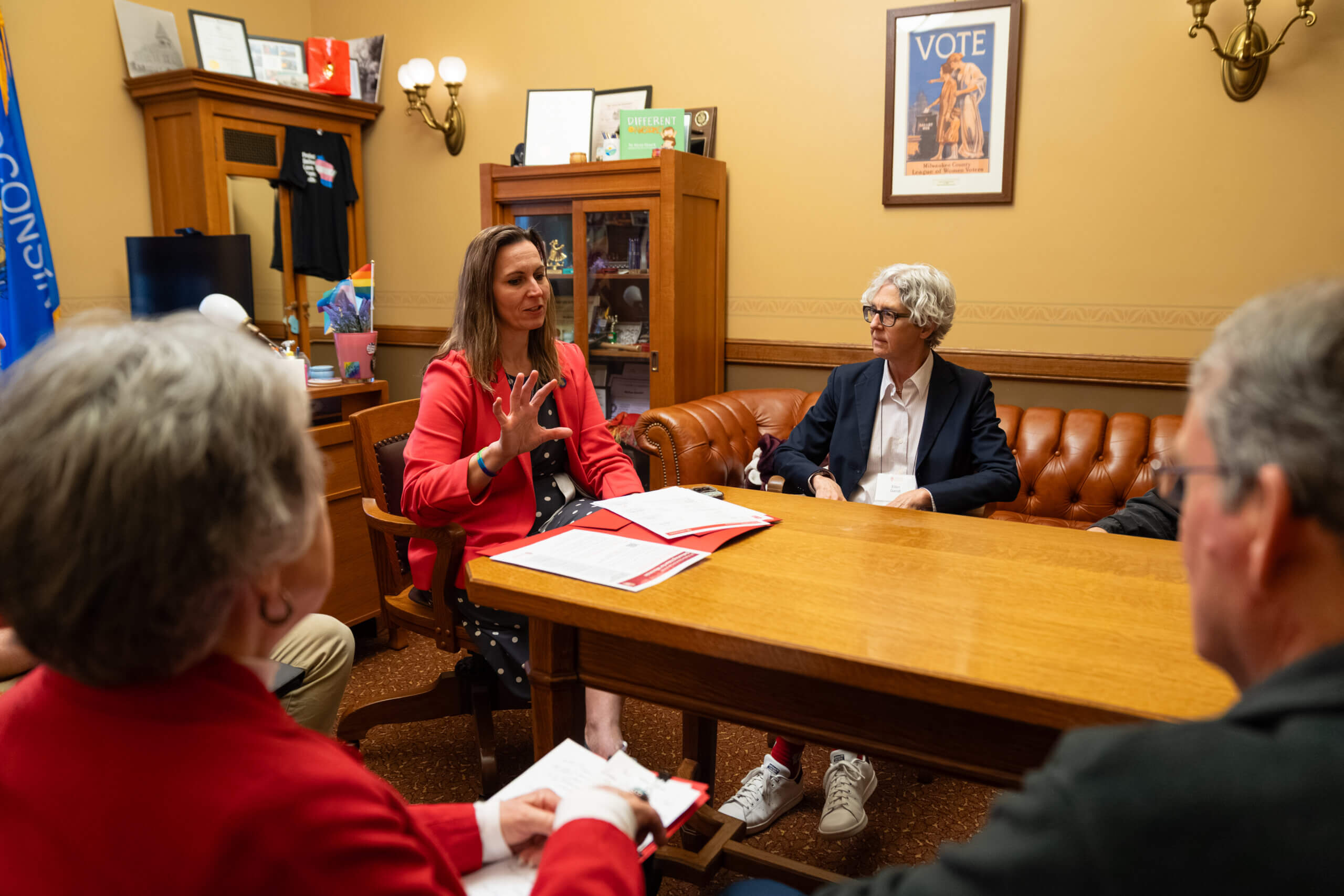
Throughout the day, alumni and friends of the university fanned out to various state assembly and senate offices to meet with lawmakers and staff to advocate for UW–Madison.
The New Economic Impact Report
Craig Thompson ’91, the UW’s vice chancellor for university relations unveiled findings from a sweeping new study — prepared by nationally respected firm Tripp Umbach — quantifying UW–Madison’s reach across the Wisconsin economy.
The headline number: $38.9 billion in combined economic impact for UW–Madison and its affiliated organizations and spin-off companies. That’s up from $30.8 billion in the university’s last study in 2021 — an increase of roughly $8 billion in five years.
The university and its affiliates support 287,000 jobs and generate $1.94 billion in state and local tax revenue.
“If you look at total employment in Wisconsin, that’s one out of every 11 jobs in the state of Wisconsin,” Thompson said. “Just sit with that for a minute. That is truly amazing.”
The report’s return-on-investment figure was equally striking: for every dollar the state invests in UW–Madison, the university generates more than $21 in economic activity across Wisconsin.
UW–Madison alone — without affiliates and spin-offs — accounts for a $13.2 billion statewide economic impact, 103,000 jobs, and $743 million in state and local tax revenue.
Crystal Potts ’10, assistant vice chancellor for university relations and senior director of state relations, walked UW advocates through the university’s key legislative priorities for the upcoming state budget cycle. Chief among them: funding to complete the long-delayed replacement of the aging Humanities Building — which carries $70 million in deferred maintenance and significant ADA compliance challenges — and authorization to proceed with a new 2,000-bed residence hall to address severe housing pressure. UW–Madison received nearly 74,000 freshman applications for approximately 8,400 spots and is currently housing students at 115 percent of designed capacity.
A Chancellor’s Farewell — and a Forward Look
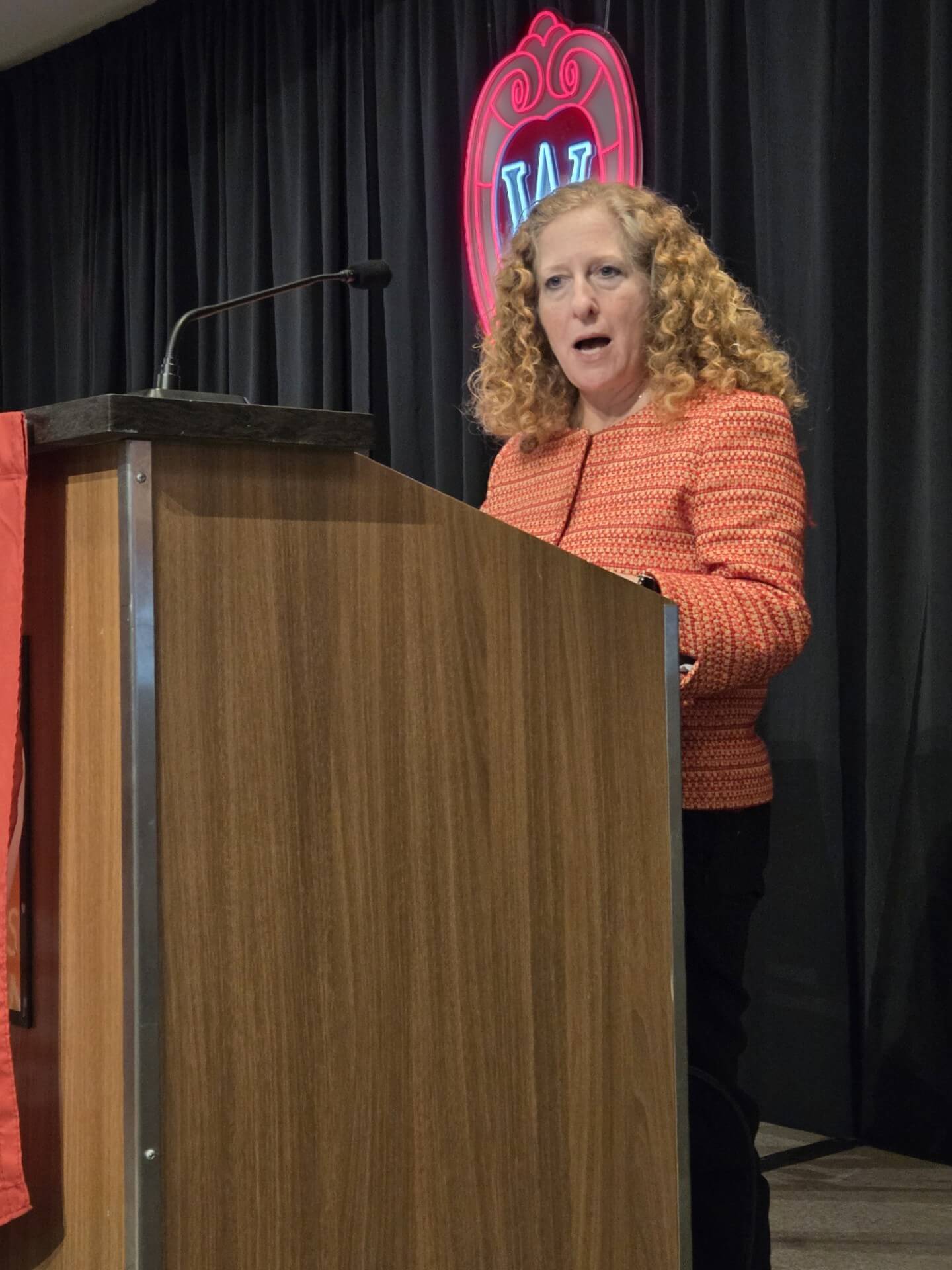
A luncheon brought one of the day’s most anticipated moments: remarks from Chancellor Jennifer Mnookin, who will depart UW–Madison after commencement to become the next president of Columbia University.
Mnookin, who has led the university since 2022, reflected on her tenure by celebrating real progress while naming the challenges that remain.
Rankings, Access, and Student Success
Under Mnookin’s leadership, UW–Madison has risen in national prominence. Time magazine recently ranked the university the fourth-best public university in the country. U.S. News and World Report places the UW 12th. Forbes named it one of only 10 public “New Ivies” in the nation, universities that offer Ivy League–level education at a public-school cost. Research expenditure rankings now place UW–Madison fifth in the country — a measure, Mnookin noted, that predates the current federal funding environment.
Nearly 20 graduate programs rank in the top 10 nationally, including the top-ranked School of Education.
For Mnookin, the rankings matter — but access matters more. She pointed to Bucky’s Tuition Promise and Bucky’s Pell Pathway, both “last dollar” scholarship programs that together now support roughly one in four in-state students. Two-thirds of UW–Madison undergraduates graduate with zero debt, and the average time to degree is under four years.
“That national story is not the truth here at UW–Madison,” she said of the broader narrative around student debt, “and I think it’s important for all of you to know that.”
This year, UW–Madison welcomed students from every one of Wisconsin’s 72 counties for the first time in years, along with the largest number of Pell Grant recipients in university history.
New Initiatives and New Buildings
Mnookin highlighted several initiatives launched during her tenure. Wisconsin RISE, a faculty hiring initiative, has brought more than 130 new faculty to campus across nearly 60 departments, with an emphasis on interdisciplinary collaboration in areas like artificial intelligence, environmental sustainability, and longevity science.
A new campuswide entrepreneurship initiative aims to build on UW–Madison’s already-strong tradition of innovation, while the Wisconsin Exchange is designed to foster civil dialogue and viewpoint diversity — what Mnookin described as a recognition that productive disagreement is itself a democratic skill.
On the facilities front, Irving and Dorothy Levy Hall — the first new humanities building in more than 50 years — opens for classes this fall, and the Phillip A. Levy Engineering Center broke ground recently, set to open in January 2029 and create 1,000 additional spots for undergraduate engineers.
Perhaps most significantly, Mnookin announced the creation of a new College of Computing and Artificial Intelligence — the university’s first new college in four decades — to be housed in Morgridge Hall this fall. The effort has attracted $100 million in philanthropic support and is explicitly designed to be a collaborator across the entire campus as UW–Madison shapes its role in the era of artificial intelligence.
Headwinds — and a Call for Flexibility
Mnookin was candid about the pressures facing the university. Federal research funding uncertainty continues to create real risk: fewer National Institutes of Health awards are reaching highly ranked proposals, and the pattern of concentrated, larger grants is squeezing out researchers who would historically have been funded.
But her most pointed message was one that longtime advocates have heard before — and that, she acknowledged, still hasn’t been fully resolved.
Wisconsin ranks among the lowest in the nation in state support for its four-year public universities. The state’s share of UW–Madison’s revenue has dropped below 10 percent, and Wisconsin ranks 43rd nationally in per-student investment in its university system.
“More funding would be great,” Mnookin said, “but what I would actually say is perhaps even more important, or at least equally important, is more flexibility.”
She pointed specifically to the university’s inability to move forward on the new residence hall — a project it could fund entirely from its own revenue — without full legislative approval.
“I’ve been here four years. In my very first fall, we began to talk about building an additional residence hall,” she said. “Four years later, although we’ve been able to do a huge number of wonderful things, we haven’t been able to get permission for that. And most other flagship schools, they do not need the whole legislature to vote yes in order to move forward with a bonded project.”
A Final Word from a Departing Chancellor
Mnookin closed with a charge to the alumni and friends of the university in the room.
“I hope you won’t just quote what you heard me share,” she said. “I hope you’ll make it more personal. Talk about the university’s impact on you, on your own life, on your livelihood, on your sense of opportunity — the ways that this university has shaped you.”
She reflected on her own experience at UW–Madison with evident emotion: “I will deeply miss this community and the work we’ve been able to do together.”
Eric Wilcots, currently dean of the College of Letters & Science and a distinguished astronomer, will serve as interim chancellor beginning May 17, overseeing the university through the coming budget cycle and a national chancellor search.
Looking Ahead
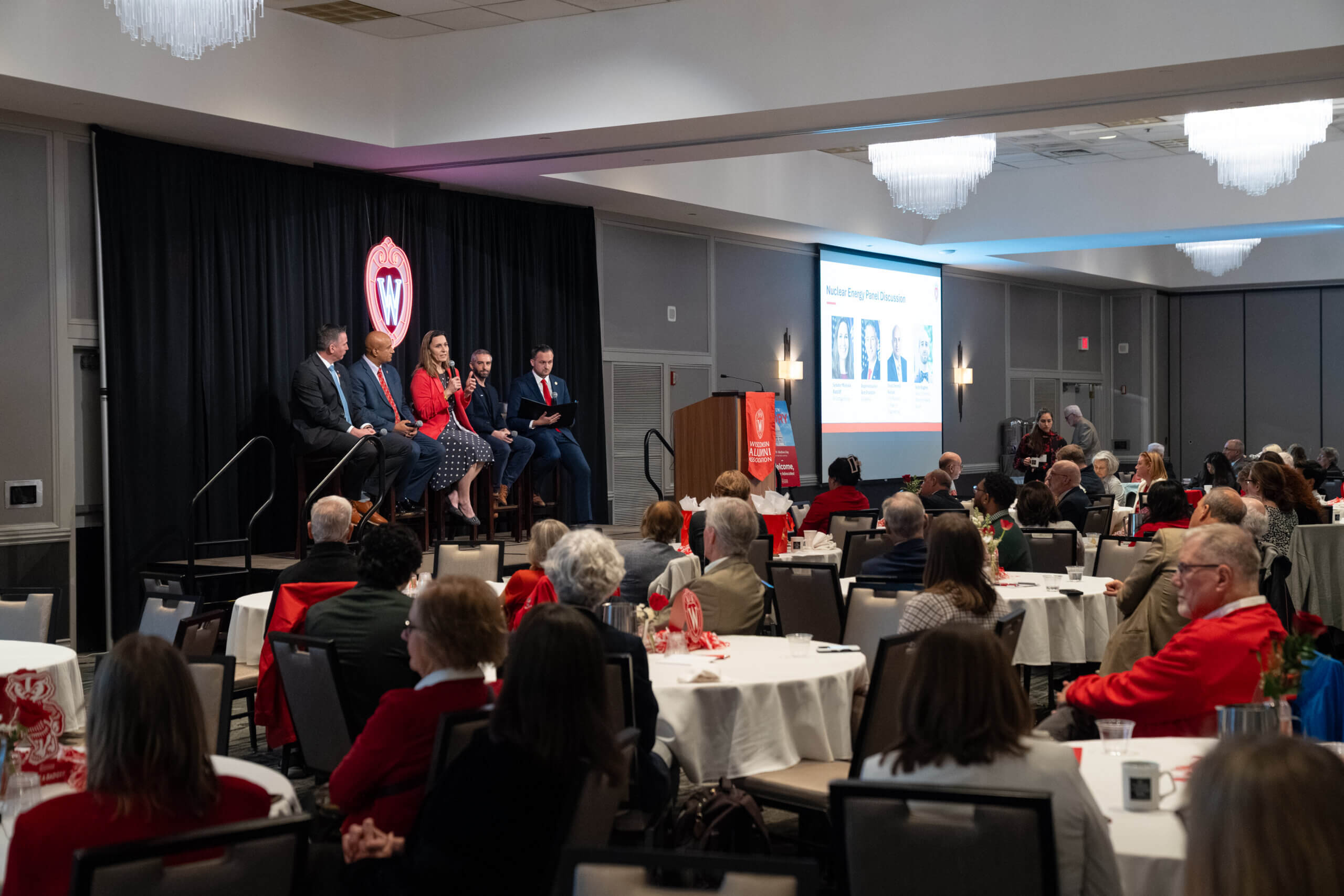
The afternoon concluded with a panel discussion on nuclear energy, featuring state legislators, UW–Madison’s College of Engineering dean, Devesh Ranjan MS’05, PhD’07, and leaders from the Wisconsin-based fusion start-up Realta Fusion — a company that sprang from UW–Madison research. The conversation underscored the university’s growing role at the intersection of research, workforce development, and Wisconsin’s clean energy future.
For advocates who made the trip to the capitol, the message of the day was consistent: the University of Wisconsin–Madison is a defining institution in Wisconsin’s economic and civic life — and telling that story, personally and powerfully, remains the most important work they can do.


